
Who Owns Quality When Everyone Owns Quality?
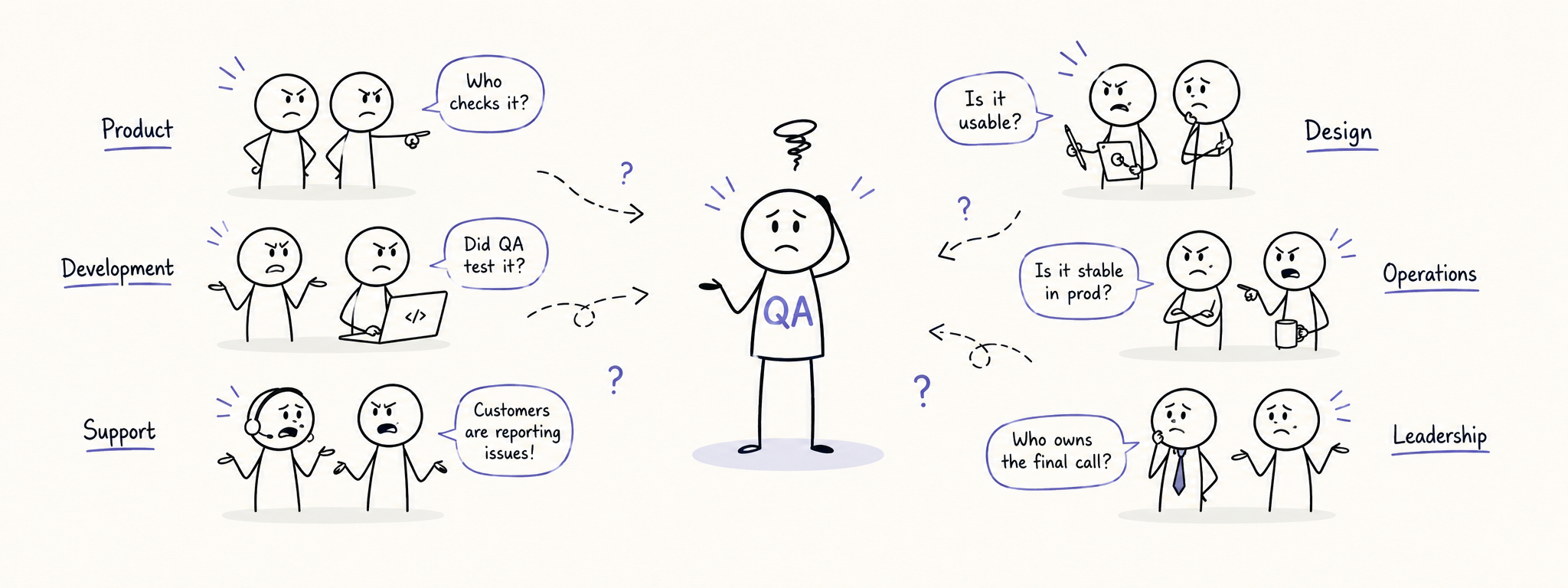
Software quality is often described as everyone’s responsibility. But without clear ownership, shared responsibility can become unclear accountability.
“Quality is everyone’s responsibility” sounds sensible.
Software quality is influenced by almost every decision a team makes. Product managers shape requirements and priorities. Designers influence usability and accessibility. Developers control implementation quality and technical safeguards. QA specialists investigate product risk. Operations teams influence deployment reliability and production visibility. Leadership decides whether teams receive enough time, skills and authority to do the work properly.
Quality clearly cannot belong to QA alone.
But the phrase creates another problem when teams use it without defining what shared ownership actually means.
When everyone owns quality, who decides whether a release is ready? Who investigates unclear behaviour? Who challenges incomplete requirements? Who maintains automated tests? Who follows up on production defects? Who has the authority to delay a risky release?
Unless those questions have clear answers, “everyone owns quality” can quietly become everyone assumed somebody else was handling it.
The strongest model is not one person owning all quality, nor a completely distributed responsibility with no structure.
Quality should be shared across the team, while specific quality decisions, activities and risks still have identifiable owners.
Why quality cannot belong only to QA
The traditional QA model often places testing near the end of development.
Product defines the feature. Developers implement it. The completed work is passed to QA. Testers then identify defects and help determine whether it is ready to release.
This arrangement makes responsibility appear clear, but it creates a misleading expectation: that QA can somehow add quality after the important product and engineering decisions have already been made.
A tester can find that an important scenario was not considered. They cannot retroactively make the original requirement clearer. They can discover that an API is difficult to validate, but they cannot recover all the time lost because testability was ignored during design.
They can report that a release is risky, but they cannot guarantee that the business will act on that information.
Developers should not be able to hand unfinished or barely checked work to QA and treat every later defect as a testing failure. Product should not be able to provide vague requirements and expect testers to determine the intended business behaviour afterwards. Leadership should not compress the schedule and then hold QA responsible for the resulting risk.
Quality is created throughout delivery, not inspected into the product at the end.
Quality is not one thing
One reason the ownership discussion becomes confused is that teams speak about quality as though it were one task.
It is not.
Quality can include whether the product solves the intended problem, whether requirements are clear, whether the implementation is correct, whether permissions are protected, whether the interface is understandable, whether APIs behave consistently, whether important journeys work across the system and whether remaining risks are acceptable to the business.
No single role has the context, skills or authority to own all of these areas.
A product manager may understand customer value but not know whether a race condition can duplicate a transaction. A developer may understand the implementation but overlook an assumption because they built the feature around it. A QA engineer may identify the release risk but lack the authority to change priorities.
That is why shared ownership is necessary. But each quality dimension still needs a practical owner.
What product managers own
Product ownership includes more than deciding which feature should be built next.
Product managers and product owners influence quality by defining the user problem, clarifying expected behaviour, explaining business rules, resolving conflicting requirements, identifying important user groups, prioritising recovery and error states and deciding which compromises are acceptable.
Product quality suffers when requirements describe only the successful path.
For example, “Users can invite teammates” leaves many unanswered questions. Can an invitation expire? What happens if the email already belongs to a member? Can a removed user accept an old invitation? Which role does the invited user receive? Can the invitation be cancelled? What happens if the workspace subscription limit is reached?
QA can help uncover these questions, but product should own the business decisions behind the answers.
A tester should not silently invent product policy because the requirement was incomplete.
What developers own
Developers own the quality of the implementation they create and change.
That includes understanding the expected behaviour, writing maintainable code, testing relevant logic, reviewing changes, handling errors safely, considering security and performance, making the software testable and investigating defects rather than simply returning them to QA.
Developer ownership does not mean developers must perform every kind of testing alone.
People naturally test from the perspective of how they believe their solution works. They know the intended structure, internal assumptions and expected execution path. That knowledge is valuable, but it can also make certain problems less visible.
Independent testing adds another perspective.
The developer should therefore own implementation confidence, while recognising that self-testing is not the complete quality strategy.
What QA specialists own
QA should not own the entire quality of the product.
But that does not make the role optional or undefined.
A QA specialist can own the quality investigation and risk-visibility process.
This may include building an understanding of product risk, asking questions that expose missing assumptions, designing appropriate test coverage, exploring user journeys and system states, validating frontend and backend alignment, checking negative and recovery behaviour, coordinating regression coverage and reporting defects clearly.
It also includes communicating what was and was not tested, explaining remaining release risk and challenging false confidence.
This is more useful than treating QA as the person who approves every ticket at the end.
A QA specialist should not become a human safety net for work that developers did not check. They should bring a testing perspective that the wider team would otherwise lack.
What designers own
Design quality is not limited to whether the interface matches a mock-up.
Designers influence usability, accessibility, information hierarchy, consistency, error prevention, feedback, loading states, recovery paths, responsive behaviour and the clarity of important decisions.
A flow can work technically while remaining difficult or unsafe to use.
Consider an account-deletion process. The API may correctly delete the account, and the UI may successfully submit the request. But quality is still poor if the confirmation text is ambiguous, the user cannot understand what data will be lost or the destructive action is easy to trigger accidentally.
QA can identify these problems during testing. Design should own the principles and intended interaction behind the solution.
What operations and platform teams own
Quality continues after code has passed its pre-release tests.
Operations, reliability and platform concerns include deployment safety, configuration consistency, observability, alerts, rollback capability, environment stability, capacity, recovery procedures, production access and incident response.
A feature is not high quality merely because it worked in a test environment.
It must also survive the deployment process, operate under real configuration, produce useful telemetry and fail in a way the team can detect and recover from.
Platform teams can provide common infrastructure and guardrails, but the product team should still understand how its service behaves in production.
“Operations owns production” can become as damaging as “QA owns quality” when it creates another handoff.
What leadership owns
Leadership owns the conditions under which quality is produced.
This is often missing from discussions about team responsibility.
Leaders influence schedules, staffing, incentives, release pressure, technical investment, access to test environments, the authority to challenge risky decisions, whether known defects are accepted or addressed and whether teams are rewarded only for shipping quickly.
A team cannot sustainably own quality if every organisational signal rewards speed and punishes caution.
Suppose a team repeatedly skips regression testing because releases are always urgent. That is not only a tester discipline problem. It may be a planning, capacity and incentive problem.
Leadership cannot delegate responsibility for the environment it creates.
Who owns the release decision?
This is where shared ownership needs a clear boundary.
QA should provide evidence about product behaviour and risk. QA can recommend that a release should not proceed. But the final business decision may belong to a product owner, engineering leader, release manager or another clearly named person depending on the organisation.
The key is that the decision is explicit.
A useful release conversation separates three things: what is known, what is the risk and who accepts the risk.
What was tested, what passed, what failed and what remains uncertain? Which users or systems may be affected, how serious is the impact and how likely is the issue? Who has the authority to release despite the known limitation?
QA should not be forced to approve a release whose business trade-offs they do not control. Equally, product or leadership should not quietly transfer accountability to QA by asking whether everything is fully tested.
No meaningful software product is fully tested. The release owner needs evidence, not a fictional guarantee.
The difference between ownership and expertise
Shared quality does not mean every person performs every activity equally.
A developer does not need to become a specialist exploratory tester. A product manager does not need to write browser automation. A QA engineer does not need to determine infrastructure architecture alone.
The team shares the outcome while using specialist expertise intelligently.
A helpful distinction is simple: everyone contributes to quality, specialists lead particular quality activities, and named people remain accountable for specific decisions.
Removing QA and saying “developers own quality now” is not automatically shared ownership.
It may simply transfer extra work to developers without replacing the specialised perspective, risk analysis and exploratory investigation that QA previously provided.
Why shift left is often misunderstood
Shift-left testing is usually intended to introduce quality thinking earlier.
That can mean reviewing requirements before implementation, discussing testability during design, identifying risk before coding, testing APIs before the full interface exists, automating important checks close to the code and involving QA throughout development.
It should not mean moving every testing task onto developers or removing independent validation.
A poorly implemented shift-left model may result in developers writing more automated checks while important product risks receive less investigation. The team appears to be testing earlier, but may actually be narrowing testing to what is easiest to automate.
The strongest shift-left practice is not “QA work happens sooner.”
It is quality decisions happen sooner.
That includes product decisions, architecture choices, observability, test-data planning and agreement on what done actually requires.
The Definition of Done helps, but it is not enough
A shared Definition of Done can turn vague quality expectations into visible team standards.
A practical Definition of Done might require acceptance criteria to be met, relevant developer tests to pass, code review to be completed, important API behaviour to be checked, accessibility requirements to be addressed, monitoring to be added where needed, critical regression areas to be tested, documentation to be updated and unresolved risks to be recorded.
This makes quality expectations less dependent on memory or individual habits.
However, a checklist does not solve every ownership problem.
“Tested” is too vague unless the team understands who tested it, at what level, in which environment and against which risks. “No critical bugs” is meaningless if severity definitions are inconsistent. “Monitoring added” provides little value if nobody owns the alerts.
The Definition of Done should clarify the baseline. It does not remove the need for judgement.
A practical ownership model
Teams do not need a complicated governance framework to improve quality ownership.
They need clarity around recurring decisions.
Product behaviour should usually be owned by product, with design, development and QA contributing. Product determines what the software should do and resolves unclear business behaviour.
Implementation correctness should usually be owned by development, with reviewers, QA and security specialists contributing. Developers own the correctness, maintainability and testability of their implementation.
Product-risk investigation should usually be led by QA or the person leading testing, with the whole delivery team contributing.
User experience should usually be owned by product and design, with QA, development, research and support contributing.
Deployment and operability should be owned by the product team, supported by platform or operations specialists.
Risk acceptance should belong to a named product or business decision-maker, using evidence from QA, engineering and relevant stakeholders.
This keeps quality shared without making ownership invisible.
Warning signs that nobody really owns quality
A team may claim to share quality while operating very differently in practice.
One warning sign is when QA becomes the final approval queue and every ticket waits for QA, even when basic developer checks were not completed.
Another warning sign is when requirements remain unclear until testing and QA repeatedly discovers fundamental business questions after implementation.
Automated tests with no maintainers are another common signal. Everyone relies on the suite, but failed or obsolete tests remain unfixed.
Production defects may also be treated only as missed test cases. The team asks why QA did not find the bug but does not examine requirements, design, code review, monitoring or release pressure.
Other warning signs include nobody being able to explain remaining release risk, quality work disappearing under deadline pressure, support knowledge staying outside the product team and every role protecting its own boundary.
Technically, everyone may be correct. Collectively, the product remains exposed.
Questions every team should answer
A short ownership discussion can expose major gaps.
Who clarifies undefined product behaviour? Who checks that developers have tested their own changes? Who leads risk analysis for a feature? Who owns test automation maintenance? Who prepares and resets test data?
Who checks production configuration? Who decides how much regression testing is needed? Who reviews support and incident patterns? Who decides whether a known defect blocks release? Who explicitly accepts the remaining risk? Who follows up after release?
The answers do not all need to name different people.
They do need to be understood before the work becomes urgent.
Quality ownership in small teams
Smaller software teams may not have a dedicated person for every discipline.
A founder, developer or product manager may perform several roles. Shared quality is still possible, but the risks are different.
In a small team, one developer may own implementation and deployment, the founder may own product policy and release risk, external or part-time QA may provide independent testing, design review may happen only when needed and support feedback may reach the team directly.
The absence of formal roles makes explicit responsibility more important, not less.
When one person performs several functions, they should consciously change perspective. The person who built the feature may need another person to challenge assumptions. A founder who wants the release date may need independent evidence about the product risk.
Founder-led teams often benefit from focused external QA because it adds another quality perspective without creating a large internal process.
Quality ownership in larger organisations
Larger organisations have the opposite problem.
They possess more specialists, but responsibility can become fragmented across product teams, platform teams, central QA, security, data teams, release management, operations, customer support and compliance.
Shared services can provide valuable expertise and standards, but they can also create waiting queues and unclear boundaries.
The right model depends on architecture, risk, regulation, team maturity and how independently teams can deliver.
The principle remains stable: teams need enough end-to-end responsibility to act, while specialist functions provide support, standards or independent oversight where the risk justifies it.
Quality ownership is also about learning
The purpose of ownership is not to identify who should be blamed when a defect escapes.
It is to make learning possible.
When a production problem occurs, a useful review asks which assumption was wrong, where the risk could have been noticed earlier, whether expected behaviour was clear, whether the system was testable, whether automated checks proved the right thing and whether the environment represented production.
It should also ask whether warning signals were available, whether incentives pushed the team toward an unsafe decision and what should change in the product or delivery system.
A narrow answer such as “QA missed the bug” may feel decisive, but it often prevents the team from understanding the actual failure chain.
Quality problems rarely have one cause. That does not mean nobody is accountable. It means accountability should produce improvement rather than convenient blame.
Conclusion
Quality should be everyone’s responsibility.
Product shapes the intended behaviour. Design shapes the experience. Developers own the implementation they create. QA brings risk analysis, independent investigation and clear evidence. Operations supports safe delivery and recovery. Leadership creates the conditions in which quality work is either possible or repeatedly compromised.
But shared responsibility does not remove the need for clear ownership.
Specific activities still need leaders. Tests need maintainers. Requirements need decision-makers. Risks need to be communicated. Release decisions need someone authorised to accept the consequences.
QA should not be expected to manufacture quality at the end of development. Nor should a team remove quality specialists, distribute their work vaguely and assume the problem has been solved.
The useful question is not simply: who owns quality?
It is: who owns each decision that determines quality, and does the team know before something goes wrong?
The strongest teams combine collective responsibility with visible accountability. Everyone contributes, specialists bring depth and no important risk is left waiting for an unnamed person to act.
Sources and further reading
- Google Testing Blog — How Google Tests Software, Part Two
- Google Testing Blog — How Google Tests Software, Part Three
- Google Testing Blog — Conversation with a Test Engineer
- Google Testing Blog — Test Engineers at Google
- Atlassian — Introducing Atlassian QA
- Atlassian — Quality Assistance Skills
- Thoughtworks — Quality Should Be Everyone’s Focus
- Thoughtworks — Agile Tester 3.0
- LeadDev — Consultative QA as a Way to Empower Engineering Teams
- Martin Fowler — Product vs Engineering
- DORA — Software Delivery Performance Metrics
- Scrum Guides — Definition of Done
- PubMed Central — Diffusion of Responsibility
- arXiv — Software Teams and Continuous Delivery
- arXiv — Code Ownership and Software Quality
Need practical QA support?
Laidoner Solutions helps software teams with manual QA, API testing, localization review, release checks and clear defect reporting.
Contact Us