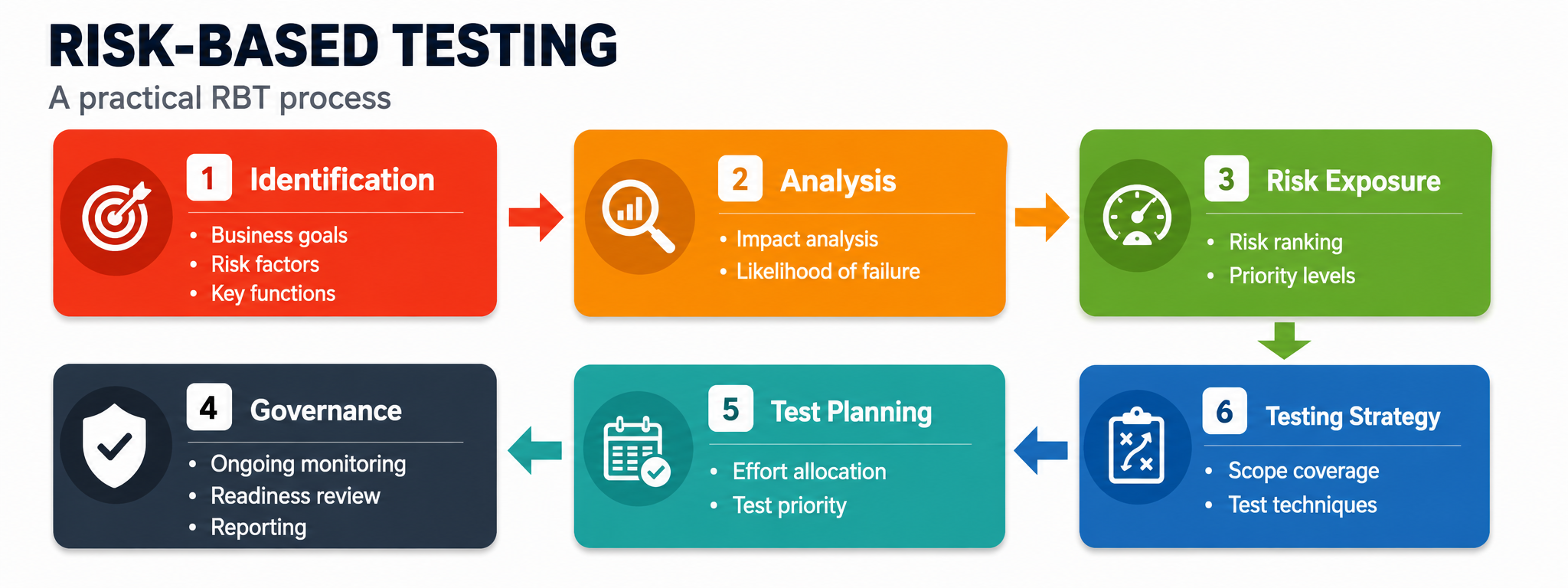

What Is Risk-Based Testing?
Risk-based testing helps software teams focus QA effort on the areas most likely to fail or cause serious impact, instead of trying to test every part of the product equally.
Most teams cannot test everything, even if they want to.
There is always limited time, changing scope, release pressure, unclear requirements, old bugs, new features, technical debt and product areas nobody fully remembers.
So the real question is not always how do we test everything?
The better question is:
What matters most if it breaks?
That is where risk-based testing becomes useful.
Risk-based testing is a QA approach where testing effort is guided by risk. Instead of treating every feature, button and page equally, the team focuses more attention on the areas that are more likely to fail or would cause bigger problems if they did.
This does not mean low-risk areas are ignored. It means testing depth is adjusted based on possible impact.
A broken footer link and a broken payment flow are not the same problem. A typo in a settings page and a permission bug that exposes customer data are not the same risk.
Good QA is partly about knowing where to look first.
What risk-based testing means
Risk-based testing means using risk to decide what to test, when to test it and how deeply to test it.
A simple way to think about risk is:
Risk = likelihood × impact
Likelihood means how likely something is to fail. Impact means how serious the problem would be if it failed.
A feature can be low likelihood but high impact. For example, a rare admin permission issue may not happen often, but if it does, the consequences could be serious.
A feature can also be high likelihood but low impact. A new UI filter may be likely to have small issues, but if the worst result is an incorrect visual state, it may not deserve the same attention as checkout, authentication or billing.
Risk-based testing helps teams make those trade-offs intentionally.
Why testing everything equally does not work
Testing everything with the same depth sounds safe, but in practice it is not realistic.
If a team treats every area equally, the important areas may not get enough attention. Time gets spread too thin. QA may spend effort on low-impact checks while risky flows only receive shallow coverage.
This is especially common before releases. The team has features to verify, regression checks to run, bugs to retest, API changes to confirm and a deadline approaching.
If everything is considered equally important, prioritisation becomes messy.
Risk-based testing adds structure. It helps the team ask better questions before testing starts.
- Which areas changed recently?
- Which flows are business-critical?
- Which areas have had bugs before?
- Which users are affected?
- Could this block login, payment, onboarding or account access?
- Could this expose data or create a permission problem?
- What would be expensive to fix after release?
This makes testing more focused. Instead of spreading attention evenly, the team spends more time where failure would matter most.
Risk is not only technical
One mistake is thinking about risk only from a technical point of view.
A technically small bug can still have a large business impact. A missing confirmation email may not be complex, but if customers rely on it to complete onboarding, it becomes important. A wrong translation may not break the system, but if it appears inside a payment flow, it can reduce trust.
Risk can come from many places:
- Business importance
- Customer visibility
- Security sensitivity
- Money movement
- Data changes
- User permissions
- Legal or compliance requirements
- Previous defect history
- Complexity of the change
- Number of users affected
- Dependency on third-party services
- Difficulty of fixing the issue after release
A good QA person looks at risk from more than one angle.
The question is not only can this break?
It is also:
What happens if it breaks?
Common high-risk product areas
High-risk areas differ from product to product, but some patterns appear often.
Login and authentication are usually high risk because they affect access to the product. If users cannot log in, most other functionality does not matter.
Payments and billing are high risk because they affect money, trust and customer relationships. Even a small mistake can become serious if invoices, charges, subscriptions or balances are wrong.
Permissions and roles are high risk because the wrong user may gain access to the wrong information or actions.
Data changes are high risk because incorrect updates, deletions or duplicates can be hard to recover from.
API endpoints behind core flows are high risk because the UI may look fine while the backend accepts invalid data, returns the wrong response or fails to enforce business rules.
Third-party integrations are high risk because teams do not fully control them. Payment providers, identity tools, email services, CRMs and analytics platforms can all create failure points.
Areas with repeated historical bugs are also high risk. If the same flow keeps breaking, that is a signal.
A simple risk matrix
A simple risk matrix can help teams decide testing depth.
It does not need to be complicated. Its purpose is to make the conversation clearer.
- Low likelihood + low impact: Light check or smoke-level coverage may be enough.
- High likelihood + low impact: Focused testing may be useful, especially if the issue would annoy users.
- Low likelihood + high impact: Planned coverage is needed because the consequence is serious, even if the failure is rare.
- High likelihood + high impact: This deserves deeper testing, stronger regression coverage, exploratory testing, API checks and possibly automation.
Instead of saying test this more, the team can explain why.
For example:
This area changed recently, has had bugs before, affects payment and would block users if broken.
That is a stronger reason for deeper testing than simply saying something feels important.
How QA uses risk to plan testing
Risk-based testing can be used before, during and after test execution.
Before testing starts, QA can review the feature or release scope and identify risky areas. This may include new logic, changed backend behaviour, new permissions, payment changes, integrations, data migrations or flows with previous defects.
During testing, QA can adjust based on what is found. If early testing reveals unexpected problems in one area, that area may need deeper investigation.
After testing, QA can communicate remaining risk. This is important because QA does not always remove all risk. Sometimes the team releases with known limitations, and that can be acceptable if the decision is informed.
A practical QA summary might say:
The core login and onboarding flows passed. Payment method update passed for standard users but was not tested for enterprise accounts due to missing test data. The new admin permission flow needs more review because two role-related issues were found during testing.
That is much more useful than simply saying testing done.
Risk-based testing helps make release risk visible.
Risk-based testing in SaaS products
Risk-based testing is especially useful for SaaS products because SaaS products change often.
A SaaS product may have user roles, workspaces, subscriptions, integrations, API-heavy flows, billing states, onboarding flows, usage limits and customer-specific configurations.
That creates many possible test combinations. Testing every combination deeply is usually not realistic, so risk helps decide which combinations matter most.
If a new change affects team permissions, QA may focus on admin, owner, restricted user and invited user states. If a change affects billing, QA may focus on trial, active, overdue, cancelled and upgraded accounts. If a change affects reporting, QA may test large datasets, empty datasets, different roles and export behaviour.
The goal is not to test randomly. The goal is to choose scenarios that represent real product risk.
Risk-based testing and regression
Regression testing is one of the clearest places where risk-based thinking helps.
As a product grows, the regression suite can become too large. If every old test case stays equally important forever, regression becomes slow and hard to maintain.
Risk-based regression helps decide which tests should run often, which should run before major releases and which can be reviewed less frequently.
High-risk regression checks may include login, payments, core workflows, permissions, API responses, data updates and areas touched by recent changes. Lower-risk checks may still matter, but they may not need the same frequency.
This also helps automation planning. Stable, repeatable and high-risk regression checks are often better automation candidates than low-value UI checks that change every sprint.
Risk-based testing and automation
Risk-based testing can help teams decide what to automate.
Automation is most useful when it protects important, repeated and stable checks.
Good candidates often include login smoke checks, critical API validation, payment flow basics, permission checks, core regression flows, data validation around important actions and high-risk areas with repeated bugs.
Automation is less useful when the product area is unclear, changing daily or requires human judgement to evaluate.
Risk-based testing prevents teams from automating something only because it is easy to automate. The better question is whether automating that check reduces meaningful risk.
Good automation strategy and risk-based testing should support each other.
Risk-based testing and exploratory testing
Exploratory testing also becomes stronger when guided by risk.
Instead of exploring the whole product randomly, QA can explore the most uncertain or risky areas first.
For example, a tester may explore failed payments in a new billing flow, admin permissions after a role model change, onboarding with missing data or API behaviour behind a frontend validation rule.
This is where exploratory testing often finds issues that scripted tests miss.
Risk gives the session direction. Curiosity helps follow the clues.
Common mistakes in risk-based testing
One mistake is using risk-based testing as an excuse to skip testing. That is not the point.
Risk-based testing is not test less and hope for the best. It is about using limited time more intelligently.
Another mistake is deciding risk only by technical complexity. A simple feature can be high risk if it affects money, data, trust or important customers.
A third mistake is never updating the risk view. Risk changes. A low-risk area can become high-risk after a new feature, integration, customer complaint or repeated bug pattern.
Another mistake is ignoring product and support input. QA should not assess risk alone. Developers, product managers, support teams and sometimes customer success may all know where users struggle or where a failure would hurt most.
Finally, some teams confuse severity after a bug is found with risk before testing starts. Risk-based testing should happen before the issue is discovered. It is a planning tool, not only a triage tool.
What good risk-based testing looks like
Good risk-based testing does not need to be heavy or bureaucratic.
It can be as simple as a short discussion before testing starts:
- What changed?
- What could break?
- Who is affected?
- What would be painful after release?
- Where have we had problems before?
- What should we test deeply?
- What can receive a lighter check?
For larger releases, it may become a more formal risk matrix, test plan or release risk summary. The important part is that testing effort matches product risk.
A good risk-based QA process helps the team understand where QA spent the most time, why those areas mattered, what was tested lightly, what was not tested, what risk remains and whether the release decision is reasonable.
That level of visibility is often more valuable than simply saying all test cases passed.
Risk-based testing helps QA focus where it matters
Risk-based testing is one of the most practical ways to make QA more useful.
It accepts a simple reality: teams cannot test everything with the same depth.
So instead of spreading effort evenly, QA focuses more attention on the areas most likely to fail or cause serious damage if they do fail.
This helps teams protect the flows that matter most, use testing time better, plan regression more intelligently and make release risk easier to understand.
Risk-based testing is not about cutting corners.
It is about making better decisions.
Because good QA is not only about finding bugs. It is also about knowing which problems would matter most if they reached users.
Need practical QA support?
Laidoner Solutions helps software teams with manual QA, API testing, localization review, release checks and clear defect reporting.
Contact Us