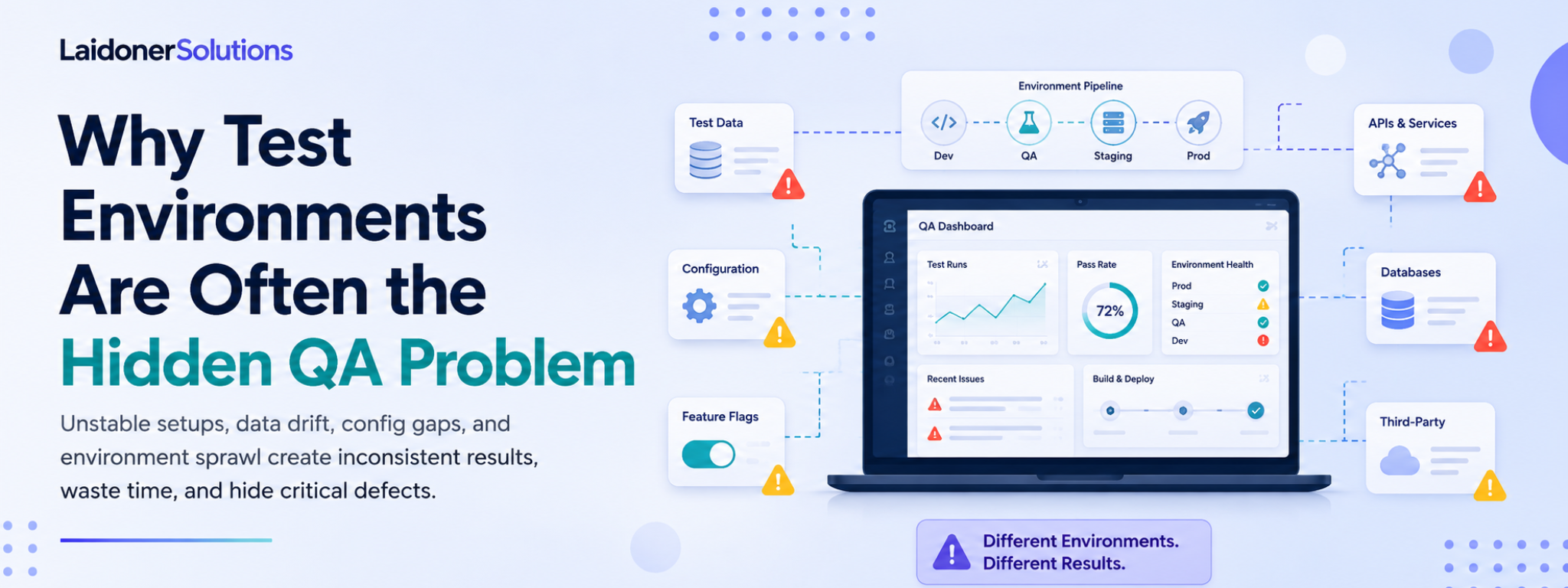

Why Test Environments Are Often the Hidden QA Problem
Weak test environments can make QA unreliable, automation flaky, bugs harder to reproduce and release confidence weaker than it looks.
Software teams usually talk about bugs as product problems.
A feature does not work. A button is broken. An API returns the wrong response. A user flow fails. A test case does not pass. A release is delayed.
But sometimes the real problem is not the feature itself.
It is the environment around the feature.
A weak test environment can make good QA difficult. It can make automation unreliable. It can make bugs harder to reproduce. It can make developers distrust test results. It can make the team spend more time asking “is this a real issue?” than actually improving the product.
That is why test environments are often one of the hidden QA problems in software teams.
They are not always visible to users. They are not always obvious in planning. They do not always appear as a clean Jira ticket. But when the environment is unstable, outdated or poorly prepared, quality work slows down fast.
What is a test environment?
A test environment is the setup where software is checked before it reaches real users.
That may include the application build, database, test data, APIs, third-party integrations, feature flags, background jobs, email or SMS services, payment sandboxes, admin panels, browser and device setup, logs and access permissions.
For a simple website, the environment may be basic.
For a SaaS platform, fintech product, marketplace, API-driven product or system with multiple user roles, the environment can become much more complicated.
Testing may depend on different account types, transaction states, backend services, permissions, notifications, scheduled jobs and external providers.
That is where problems start.
The team may say “QA is testing the feature,” but QA is actually testing the feature inside a system.
If that system is unreliable, the test result becomes harder to trust.
Why test environments become a QA problem
A test environment becomes a QA problem when it stops representing the product clearly enough.
That can happen in many ways.
The build may be outdated. The database may contain broken or unrealistic data. Feature flags may differ from production. A third-party sandbox may be down. Emails may not send. Background jobs may not run. API endpoints may point to the wrong service.
Test accounts may be missing permissions. The admin panel may show different data than the user interface. One developer may deploy a branch that breaks another tester’s work.
None of these problems are unusual.
But they create a serious testing issue: QA can no longer easily tell whether the product is broken, the environment is broken or the test data is broken.
That is why environment problems should not be dismissed too quickly.
A failing test may be annoying, but it may also be telling the team something important.
The “works on my machine” problem
One of the most common symptoms of a weak environment is the classic line: “it works on my machine.”
That may be true.
But it does not solve the quality problem.
If something works locally but fails in staging, review, QA or production-like testing, then the team needs to understand why.
Maybe the local setup has different configuration. Maybe the database state is different. Maybe a service is mocked locally but real in staging. Maybe environment variables are missing. Maybe permissions are different. Maybe the browser, operating system or dependency version changes the behaviour.
That confidence is difficult to build if each environment behaves differently in ways nobody understands.
A test environment does not need to be identical to production in every possible way. That is often unrealistic and sometimes unsafe.
But the important differences should be known.
Unknown differences create false confidence.
Flaky tests are often environment signals
Teams often blame flaky tests on automation.
Sometimes that is correct. The test code may be weak. It may rely on bad waits, unstable selectors, race conditions or poor setup.
But flaky tests can also reveal environment problems.
A test that fails only in one browser, only on one CI runner, only with one Node version or only after a certain deployment may not be “just flaky.”
It may be exposing an environmental dependency the team does not understand yet.
This is why simply rerunning failed tests is not always enough.
Rerunning may get a green result, but it does not explain why the first result failed.
If the team ignores that too often, trust in the test suite slowly disappears.
Test data is part of the environment
Test data is often treated like a small setup detail.
It is not.
Bad test data can make good testing almost impossible.
A tester may need users in different states, contracts with specific statuses, completed transactions, failed payments, expired sessions, invoices, admin actions, localization strings, old records, new records, restricted accounts or products with unusual configuration.
If that data does not exist, QA has to create it. Sometimes that is useful because the data creation flow also needs testing.
But when the goal is focused testing, missing data creates delay.
Even worse, unrealistic data can hide real bugs.
A product may work with perfect clean data but fail when users have old history, missing fields, unusual permissions, duplicated records or partially completed flows.
For QA, environment quality and data quality are connected. You cannot separate them cleanly.
Third-party services make environments fragile
Modern products rarely work alone.
They depend on payment providers, authentication services, email tools, SMS providers, blockchain networks, analytics services, identity verification, maps, AI providers, CRMs, customer support tools and many other external systems.
That makes testing harder.
A feature may work perfectly inside the product but fail because a sandbox is down, a provider changes a response, a webhook is delayed, a test API key has limited access or the third-party service behaves differently from production.
This is especially important for API-driven products and transaction-style flows.
A contract flow, checkout, loan request, escrow step, verification process or notification chain may depend on several systems working together.
When one part is unstable, QA needs to know whether the product handled the failure correctly.
That means the test environment should not only support happy path testing. It should also allow controlled failure testing where possible.
Environment gaps slow down external QA
External QA is most useful when the tester can focus on product behaviour quickly.
That becomes difficult when the environment is not ready.
Access may be missing. Test accounts may not work. The build may not include the latest changes. API credentials may be incomplete. Test data may be impossible to create.
The bug tracking tool may not be ready. The staging environment may be unstable. The team may not know which version should be tested.
This does not mean external QA cannot help.
Sometimes the first value of an external QA review is showing that the environment itself is blocking proper testing.
That is useful information for the team.
But if the goal is fast release feedback, the environment needs some preparation before testing starts.
At Laidoner Solutions, this is handled by clarifying scope, access, test data, affected areas and reporting expectations before testing begins.
The goal is not to create unnecessary process. It is to remove avoidable friction so the actual QA work can focus on product risk.
Poor environments create false release confidence
A weak environment can create two opposite problems.
The first problem is false alarms. The team sees failures that are caused by unstable data, outdated builds or broken test setup. People waste time investigating noise.
The second problem is more dangerous: false confidence.
The team sees green tests and assumes the release is safe, even though the environment did not properly represent the real product.
Maybe important integrations were mocked. Maybe notifications were disabled. Maybe the data was too clean. Maybe permission differences were not tested. Maybe only one user role was covered. Maybe background jobs were not running.
A green result is only useful if the test conditions were meaningful.
Testing in a poor environment can make a team feel safer than it actually is.
That is why QA summaries should not only say what passed or failed. They should also explain the testing limitations.
Useful QA summaries include environment limits
A useful QA summary should make the test conditions clear.
For example: tested on staging build X, email sending was disabled, payment provider sandbox was unavailable, admin role testing was limited, only the new-user flow was covered, regression was blocked by missing test data or production parity was not confirmed.
This kind of information helps teams make better release decisions.
It does not make the testing look weaker.
It makes the confidence more honest.
That matters because the real release question is not only whether testing happened.
The better question is whether the testing conditions were strong enough to support the decision being made.
What good environment preparation looks like
A better test environment does not need to be perfect.
It needs to be understandable, stable enough and suitable for the testing goal.
Before a release or external QA engagement, teams should check whether the environment supports the work they expect QA to do.
Useful questions include: is the correct build deployed? Are feature flags configured correctly? Are test accounts available for the required user roles? Is the test data realistic enough? Are third-party sandboxes working?
Are email, SMS, webhook or background job flows enabled or intentionally disabled? Are API endpoints pointing to the correct environment? Are logs available if investigation is needed? Are known environment limitations documented?
Is someone responsible for fixing environment blockers? Does QA know what is out of scope?
This is not bureaucracy.
It is the foundation for useful testing.
Where Laidoner Solutions helps
Laidoner Solutions does not replace a client’s infrastructure, DevOps or development team.
But QA can help make environment problems visible.
During manual testing, exploratory testing, regression checks, API validation or product quality review, environment issues often show up as blocked flows, inconsistent states, missing data, unclear errors or failures that cannot be reproduced reliably.
The value is in identifying those issues clearly and separating them from product defects where possible.
For example, Laidoner Solutions can help by checking whether the test environment supports the agreed testing scope, reporting environment blockers clearly, validating API behaviour across expected and failed states, identifying gaps in test data or user role coverage, documenting limitations in the QA summary and highlighting release risks caused by unstable environments.
This matters because a team cannot improve what it cannot see clearly.
If the product is risky, QA should show that.
If the environment is making testing unreliable, QA should show that too.
Final thoughts
Test environments are easy to ignore because they sit behind the visible product.
But they shape almost every part of QA.
A strong environment helps testers focus on product behaviour. A weak environment creates doubt, delays, false failures and false confidence.
When teams say “QA is slow,” “automation is flaky,” or “testing keeps finding weird issues,” the environment should be part of the investigation.
Maybe the product has a bug. Maybe the test has a bug. Maybe the data is wrong. Maybe the environment is unreliable.
Good QA helps separate those possibilities and explain what the team can actually trust.
That is why test environments are often the hidden QA problem.
They are not the most exciting part of software quality, but they are one of the parts that can quietly decide whether testing is useful or misleading.
Sources and further reading
- Ministry of Testing — Test Environment
- Michael Bolton — On Flaky Tests and Testing Pathology
- Martin Fowler — Continuous Delivery
- A Systematic Evaluation of Environmental Flakiness in JavaScript Tests
- A Qualitative Study on the Sources, Impacts, and Mitigation Strategies of Flaky Tests
- Ministry of Testing — Why Test Data Is Harder Than Test Automation
- Martin Fowler — Deployment Pipeline
Need practical QA support?
Laidoner Solutions helps software teams with manual QA, API testing, localization review, release checks and clear defect reporting.
Contact Us