
Remote Work Is Not Just a Privilege
Remote work is not possible for every job, not automatically deserved, and not something people should feel guilty about. It is a trade-off, a responsibility and often the result of building skills that can travel.
Remote work is often discussed in a strange way.
Some people talk about it as if it is only a privilege. Others talk about it as if every job should be remote and every company that disagrees is outdated. Both views miss the point.
Remote work is not possible for every job. A nurse, electrician, mechanic, warehouse worker, construction worker, chef or machine operator usually cannot do the core work from a laptop in another country. Some work is tied to a physical place because the work itself is physical. That does not make those jobs less valuable. It just means the nature of the work is different.
But for many digital roles, remote work has become a real option. Not because people are magically entitled to it, but because the work can be done through skill, communication, trust and results.
That distinction matters.
Remote work is not automatic
I do not think remote work should be treated as something every person can automatically handle well.
To be frank, many people are not fit for remote work. Not because they are bad people, but because remote work requires a level of self-structure, competence and responsibility that not everyone has developed.
When nobody is watching directly, some people lose focus. Some communicate poorly. Some disappear. Some let the freedom turn into weak output. Some treat remote work like less work. And it shows in the results.
That is where the difference becomes clear. Compare that with someone who performs the same or even better remotely. Someone who communicates clearly, manages their own time, delivers without being chased, understands priorities and takes responsibility for the outcome.
That person is not just enjoying a privilege. They are proving that they can be trusted with more freedom.
Remote work exposes people. It shows who needs constant external structure and who can create their own.
It took years to make it realistic
For me, remote work was not something I simply expected at the beginning.
It took years to reach a point where it became realistic. I worked mostly in offices before. I gathered experience. I learned how companies work. I learned how to be useful. I had to build enough competence so that eventually my work, not my physical location, became the thing that mattered most.
That changes how I see the topic.
I do not compare remote work with manual labour in an arrogant way, because I have also worked physical jobs and understand that side too. Some jobs simply cannot be done remotely. You cannot test that idea with ideology. The work either requires physical presence or it does not.
But I also do not like when people use the word “privilege” in a way that makes remote workers feel guilty for choosing a different path.
People choose different routes. They build different skills. They accept different trade-offs. They take different risks. Remote work can be one result of that.
Every job has benefits and costs
Every type of work has its own advantages and disadvantages.
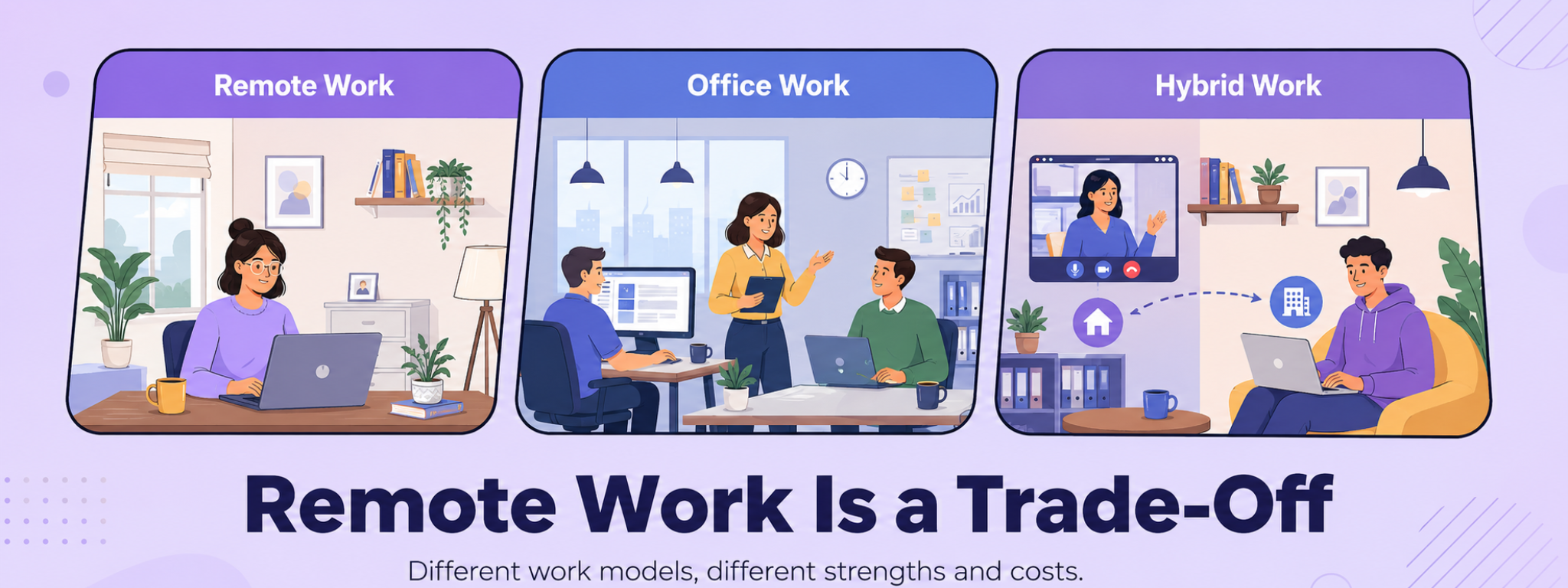
Office work can give structure, social contact, easier learning from others and clearer boundaries between work and home. It can also mean commuting, office politics, less flexibility and being judged by presence instead of output.
Physical work can give practical skills, movement, visible results and a clear separation between work and personal life. It can also mean less location freedom and less control over when and where the work happens.
Remote work can give flexibility, time, independence and better quality of life. It can also create isolation, blurred boundaries, time zone problems and pressure to prove that you are actually working.
None of these paths are perfect. The point is not that remote work is better than every other form of work. The point is that it is a different trade-off.
Flexibility has real value
For many people, remote work is valuable because it gives back time.
Less commuting. More time with family. More time for health. More time for learning. More room to travel, live in another country or stay close to people who matter.
That is not a small thing.
Some people may accept a slightly lower salary for remote flexibility. Others may accept a much larger salary difference if moving to a lower-cost country gives them a better life overall. The number is personal. For some, the freedom is worth far more than a small percentage on paper.
This is why remote work cannot only be measured through salary. Time, location and control over your daily life have value too.
Companies benefit as well
Remote work is often presented as a benefit given to the employee, but companies also gain from it.
They can hire outside one city. They can access people with more specific skills. They can reduce office costs. They can retain people who may otherwise leave. They can build teams around competence instead of geography.
So remote work should not be framed as charity from the company. It is an agreement.
The company gives flexibility. The worker gives results. That is the fair exchange.
When companies frame remote work mainly as a privilege, it can become a negotiation tool. The message becomes: “You should be grateful we allow this.” That can make people accept weaker pay, weaker boundaries or more monitoring because they feel they have already been given something special.
But if the person delivers well, the company is benefiting too.
Results should matter more than control
The real question is simple: can the person do the work well without being physically watched?
If the answer is no, remote work may not be the right setup for that person or role. If the answer is yes, then location should matter much less.
A person who delivers consistently from another country is more valuable than someone sitting in an office producing weak results. Presence is not the same as performance.
This is where many companies still struggle. They confuse visibility with productivity. They feel safer when people are in the building, even if the actual output is not better.
Remote work forces a cleaner question: what are the results?
That can be uncomfortable for both sides. For employees, it removes excuses. For managers, it removes the illusion of control.
Remote work is not a shortcut
Remote work can look easy from the outside, but it is not a shortcut.
You need to manage yourself. You need to communicate before things become unclear. You need to make your work visible. You need to respect deadlines. You need to protect your own routine. You need to know when to work and when to stop.
Nobody is going to create the structure for you every day.
That is why remote work works very well for some people and badly for others. It rewards people who can operate with trust. It exposes people who need constant pressure to stay useful.
Final thoughts
Remote work is not possible for every job. It is not perfect. It is not automatically deserved. And it should not be treated as something people need to feel guilty about either.
It is one possible outcome of building skills that can travel.
For some people, it takes years of office work, learning, mistakes and experience before remote work becomes realistic. For others, it may never fit their role or personality. That is fine too.
The important thing is honesty.
Remote work is not only a privilege. It is also a responsibility, a trade-off and often a result of becoming useful enough that your location matters less than your output.
And in a world where people value time, freedom and flexibility more than ever, that kind of option is worth building toward.
Need practical QA support?
Laidoner Solutions helps software teams with manual QA, API testing, localization review, release checks and clear defect reporting.
Contact Us