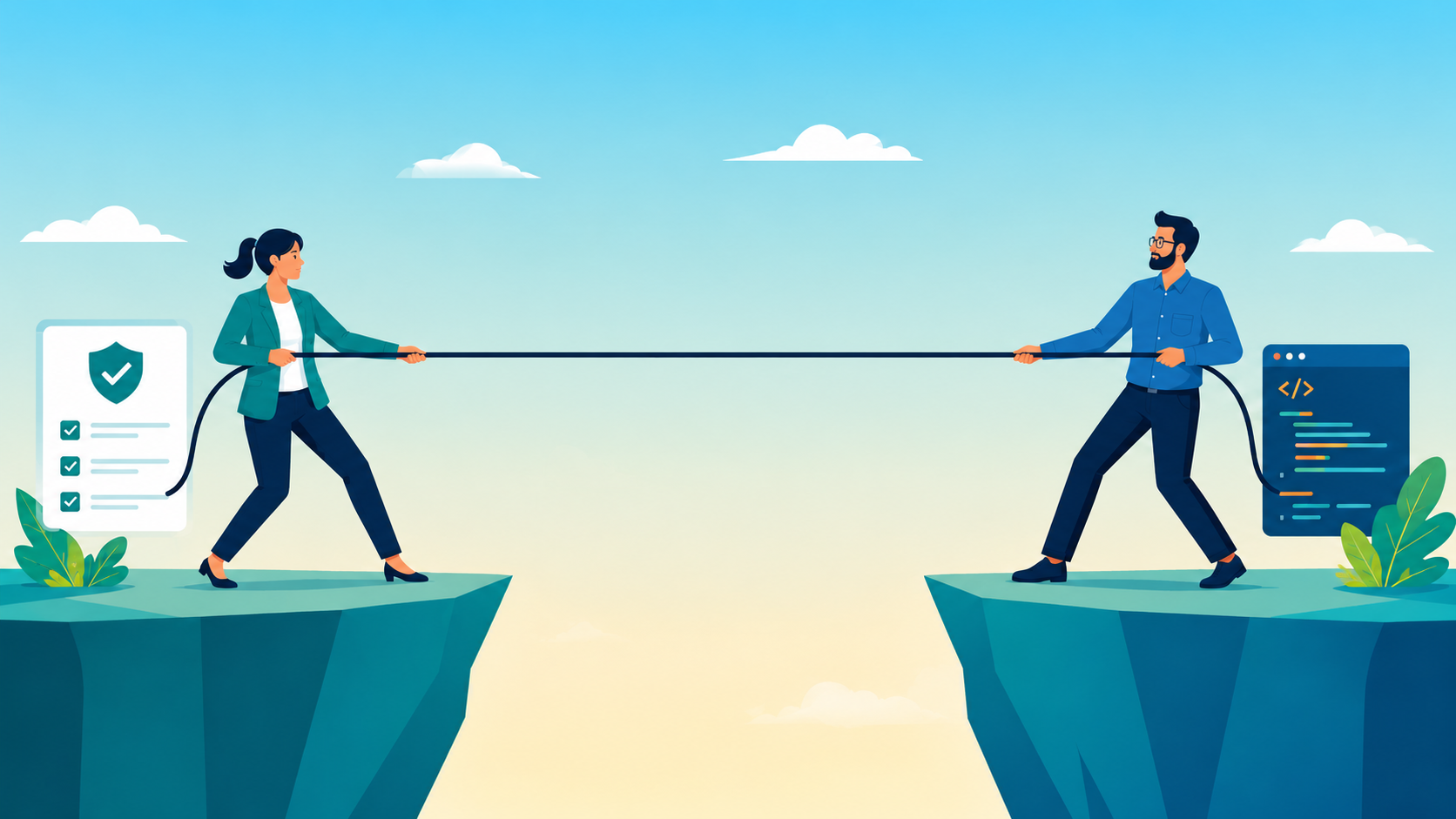

Stop Thinking QA Is Less Important Than Development
QA and development are different professions with different strengths. Strong QA makes risk visible, prevents defects earlier and helps shape how products are built.
“You do not produce anything. You just check what other people do.”
I think more testers have had this thought than they would openly admit. And to be fair, it is not difficult to understand where it comes from. Developers build things. They write code, create features and make visible changes to the product. Their work is easy to point at. QA is different. You review, question, test and often find a problem in something someone else has already built. This can sometimes create the feeling that development is the “real” work and QA is simply there to inspect it afterwards.
But that way of thinking no longer makes much sense. Moving from QA into development should not automatically be seen as a promotion or the natural next step. A good tester will not necessarily become a good developer, and a strong developer will not automatically become a strong tester. They are different professions, with different daily routines, different problems and often a different way of thinking. But both roles are working toward the same result: building a product that works, meets the requirements and reaches a reasonable standard of quality.
It is exactly because the two roles are different that QA has value. And if QA is involved properly, the role goes much further than catching bugs. You start preventing them.
An inferiority complex that should have disappeared already
There was a time when testing really did sit at the end of the development process. The software was designed, the feature was built, development finished and then the tester arrived to check whether everything worked. That model naturally positioned QA at the end of the chain. Even though quality principles have long pushed for testing involvement throughout the development lifecycle, in practice testers have often been brought in far too late.
The strange part is that many people still think about QA this way. Software development has changed. Teams moved toward shorter development cycles, faster feedback and continuous delivery. The goal is to understand problems quickly, while they are still easier and cheaper to correct. That change also transformed the tester’s role.
QA is no longer only executing a list of test cases after development finishes. A modern QA engineer may be reviewing requirements, discussing acceptance criteria, validating APIs, investigating backend behaviour, supporting automation, analysing release risk and working closely with product and development throughout the sprint.
The profession has expanded significantly. There are manual testers, automation engineers, QA engineers, SDETs, performance specialists, security-focused testers and now people increasingly working around the quality of AI-based systems. When you actually look at the amount of knowledge a QA professional can build, the idea that testers are somehow less legitimate than developers becomes difficult to defend.
There is another important change happening as well. Writing code is no longer something only developers can do. AI can now generate surprisingly large amounts of code from a relatively simple instruction. But generating code and building a good product are not the same thing. Code still needs to meet a business need, behave correctly, handle the unexpected, make sense to the user and work together with the rest of the system.
The need for people who understand risk, users and overall product quality has not disappeared because code is easier to generate. I would argue it has become even more important.
The real difference is often visibility, not value
There can be tension between developers and QA, but I do not think it is usually about intelligence or technical ability. A lot of it comes down to visibility.
Imagine a familiar situation. A company is under pressure and a developer completes a complicated feature quickly. The feature is shown, people are impressed and it gets released. But behind the feature, documentation is weak, test coverage is missing and parts of the implementation are fragile. The developer moves to the next feature. QA stays with the current one.
Now QA finds the last-minute defects. QA raises the release risks. QA reports that something is still unstable. And if production goes wrong, QA often ends up involved in investigating the problem as well. The developer was associated with creating the feature. QA becomes associated with the bad news.
That is a strange imbalance. The visible and immediate work gets attention, while preventive work is much quieter. A production incident creates meetings, alerts and urgent fixes. A QA engineer stopping the same issue during a requirement review may leave behind one comment in a task. Both actions can have a large impact, but only one of them looks dramatic.
Recognising this difference in visibility is important. But there is another part of the problem which is more personal: how do you see your own value?
Own your value
A lot of this starts with confidence. Not confidence based on a job title and not confidence because somebody from management told you that you are doing a good job. You need to understand what you actually bring to the work yourself.
Start with the personal qualities you had before you ever worked in QA. What have you always been naturally good at? What type of problems do you notice? How do you react when something does not make sense? These things matter more than people sometimes realise.
Some skills are difficult to teach through a course. Enthusiasm is one of them: the energy to keep investigating instead of stopping at the first answer, and to see a problem as something interesting to solve rather than only an obstacle. Critical thinking is another. It is the habit of questioning things other people already accepted. Why does the system work this way? Should both users be able to perform this action? What happens if the process is interrupted here?
Curiosity matters just as much. A good tester wants to understand what is happening behind the screen and is not satisfied simply because the happy path worked once. Then there is creativity: thinking of a scenario nobody included in the test case, connecting two product areas that seem unrelated, trying the action twice, changing the state halfway through or looking at the API when the UI behaviour does not make sense.
These are not secondary skills. They are some of the things that make a strong tester useful. A tool can be learned. A testing framework can be learned. But curiosity and the instinct to question behaviour are much harder to manufacture.
Your professional strengths
Now think about the work you have already done. Not only the bugs you reported, but the moments where your QA experience genuinely changed the outcome.
Think about the bugs you prevented instead of finding. Maybe you reviewed a requirement and noticed that an important state had not been considered. Perhaps you asked one question in refinement and the entire feature logic changed before development started. That defect never reached the application and will never appear in a bug report, but it may have been one of your most valuable contributions.
Then there are the processes you improved. Maybe you created a regression suite that made releases easier, introduced clearer bug reporting, built a checklist that stopped important steps from being forgotten, improved API testing or cleaned up test cases that nobody trusted anymore. The best QA work often leaves something behind: a process, a testing structure, a clearer way of working or something that continues helping the team after the original task is finished.
There are also the risks you raised when nobody agreed. Most experienced QA engineers have had this happen. You raise a concern, everyone thinks the scenario is unlikely, the release continues and later the exact problem appears. This is not about enjoying the moment and saying, “I told you so.” It is about recognising that your judgement has value. QA regularly works with uncertainty. You will not always be correct, but when you notice a risk, explain it properly and provide evidence, your opinion deserves to be part of the decision.
And then there are the releases you helped protect. Think about the critical defect you found shortly before production, the strange edge case nobody considered, the incorrect permission, the repeated request that created duplicate data or the backend behaviour that did not match the UI. Sometimes one finding can completely change the risk of a release.
QA professionals do this kind of work every day. The problem is that much of it does not appear in normal dashboards. How do you measure the cost of a defect that never reached production? At first, it sounds impossible. But you can start measuring the work earlier.
Prevented defects can leave a trace
A defect stopped during a requirement review still creates evidence. Maybe it is a review comment, a clarification, a risk raised during refinement or a change to acceptance criteria. Instead of treating these moments as casual conversations, teams can start recording some of them.
You might distinguish between issues identified during review, issues found during development, defects found during QA and defects found in production. Suddenly, the preventive work becomes easier to see. You can start understanding how many problems are being identified before they reach the final testing stage.
You can also start asking better questions. Which product areas create the most early concerns? Where are requirements repeatedly unclear? Which flows create the most production defects? Are important risks being found earlier over time?
QA is already expected to help teams understand the quality of a product. Part of that work is documenting how the team reached its current quality level. If preventive work is completely invisible, it is much harder to improve it.
Show your value
Making QA visible can happen in many ways, but there is one simple principle I keep coming back to: testing work should leave something useful behind.
Every QA activity creates some form of output. The output does not always need to be a formal document, but there should be enough evidence that somebody can later understand what was done and why.
Requirements and specification reviews may produce review comments, clarified requirements, identified risks or missing acceptance criteria. Test analysis may produce test conditions, risk assessments, coverage areas and traceability information. Test design may produce test cases, test scenarios, test data, checklists and coverage matrices.
Test implementation may result in test suites, automated checks, testing environments and execution plans. Test execution usually creates the most visible evidence: execution results, defect reports, screenshots, request and response evidence and incident information. Regression and automation may produce regression suites, automated results, maintenance updates and coverage improvements.
Monitoring and control can include QA summaries, test progress, quality metrics and current risk status. At the end of testing, the output may include test summary reports, release concerns, release recommendations, lessons learned and updated test assets.
These things are more than documentation. They show the decisions you made, what you investigated, where risk was found and what the team actually knows about the product. When QA work leaves no trace, a large part of its value disappears with the person who performed it.
Work closely with development
QA is much more effective when it is present throughout development. Even the best final testing session has limits if QA only sees the feature after every important decision has already been made.
Get involved earlier. Join specification discussions, take part in planning, review acceptance criteria and be present when complicated product flows are discussed. Where appropriate, join technical conversations that affect testability or product risk.
Work with developers. Pair test difficult areas. Review the same network request. Discuss state changes. Ask why the system behaves the way it does. This does not mean turning QA into development. It means bringing a quality perspective while the product is still being shaped.
Preparation matters here. Do not join meetings only to say, “QA should be involved.” Understand the topic, review the task, think about the risks and come with useful questions. When QA consistently contributes something valuable to these conversations, the team’s view of the role changes naturally.
Over time, QA stops being the person who validates work after the fact. You start influencing how the team thinks about quality while building the feature.
Look beyond development efficiency metrics
Companies like measuring development efficiency. That is understandable. The problem is that teams sometimes start measuring how quickly they produce software before they properly measure the quality of what they are producing.
Then the visible numbers start driving behaviour. Commits, sprint velocity, deployment frequency, lead time, number of features shipped and now, with AI, perhaps even the amount of generated code or work completed within a certain period.
These numbers are easy to count. That makes them attractive. But easy to count does not always mean useful on its own.
A team can increase deployment frequency while production defects also increase. Velocity can rise while technical debt becomes worse. More features can be shipped while users struggle with critical flows. This creates an illusion of progress. The team optimises output while the product needs outcomes.
For QA, this can be frustrating. You may have limited control over how many features development produces, while pressure for speed can create more quality risk. That is why QA needs to look beyond development efficiency metrics.
Bring quality signals into the discussion: production defect rate, severity of escaped defects, coverage of high-risk areas, mean time to detect problems, mean time to resolve them, release stability over time and repeated regression areas.
These metrics may not look as exciting as “we doubled deployment frequency,” but they often say much more about the real health of the product.
Look beyond technical product metrics as well
QA can also help connect product quality with the actual user experience. This is an area where working with product becomes especially useful.
Technical metrics matter, but the user does not care that the API returned 200 OK if the screen still shows incorrect information. Look at user quality as well: user-reported defects, success rates on important journeys, drop-off in critical flows, failed transactions, API error rates, performance on key features, repeated support complaints, perceived performance and recovery after errors.
This is where QA can connect technical behaviour with what users actually experience. A system can technically behave according to the requirement and still be difficult to use. A feature can pass every scripted test and still confuse users. QA should be capable of noticing that difference.
Stop waiting for recognition
Testers often feel that their work is not recognised enough. Sometimes that is true. Managers may not fully understand QA. Developers may only interact with QA when a defect is reported. Even testers themselves sometimes struggle to explain the value of their work.
But waiting for somebody else to notice everything you do is not a great strategy.
Make the work visible. Produce useful testing output. Raise specific risks. Explain why a defect matters. Connect repeated issues to wider product problems. Track quality signals. Get involved earlier and help prevent the same defect from happening twice.
Recognition built through useful work and clear evidence is much stronger than recognition you wait for.
So stop asking whether QA is equal to development. The roles do not need to be identical to have equal importance. Understand your value, make the work visible and help the team see quality before production forces them to.
Then you stop being the person who checks what somebody else built.
You become one of the people shaping how the product gets built.
Need practical QA support?
Laidoner Solutions helps software teams with manual QA, API testing, localization review, release checks and clear defect reporting.
Contact Us