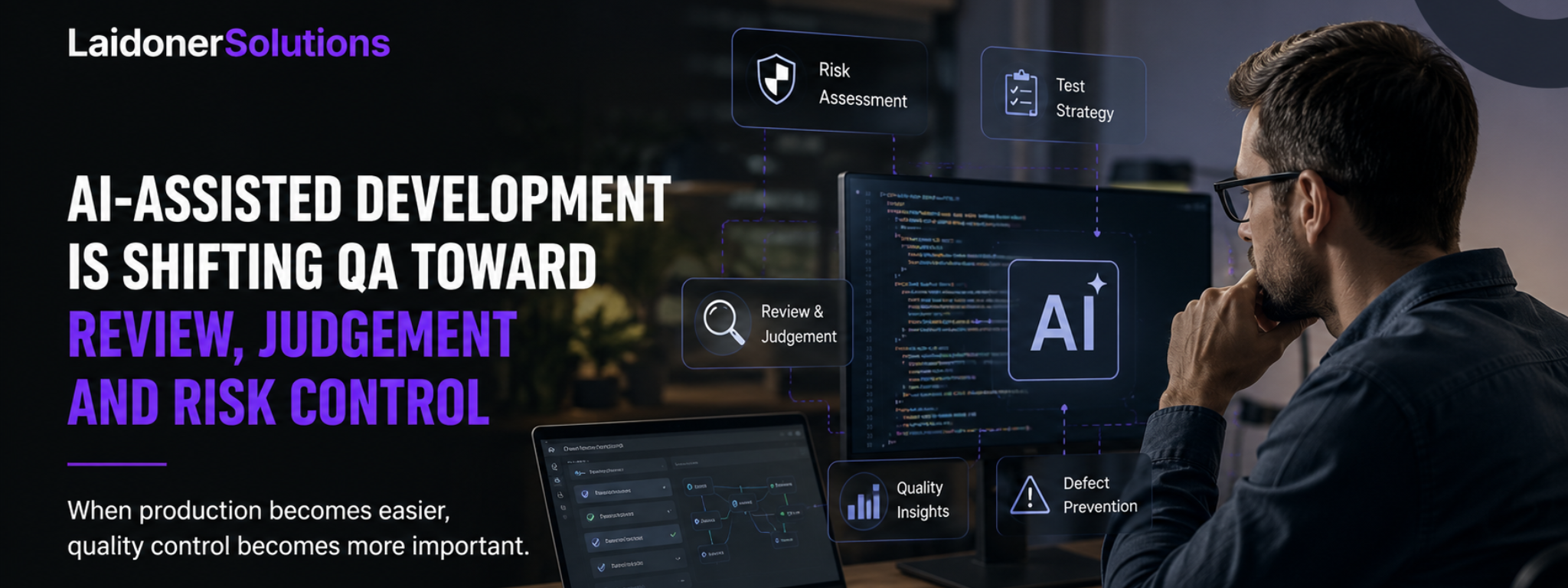

AI-Assisted Development and the New Age of Quality Control
AI-assisted development makes software production faster, but it also makes quality control, product judgment and QA risk analysis more important.
Every major technological shift changes the value of human work.
It does not usually remove value altogether. It moves it.
The printing press did not make thinking worthless. It made copying less valuable and interpretation more valuable. Industrial machines did not make production worthless. They changed who could produce, at what scale and under whose control. The internet did not make information worthless. It made information abundant and judgement scarce.
AI-assisted development is creating a similar shift in software.
The value of coding is still high. But the value is no longer only in producing code line by line. More of the value is moving toward deciding what should be built, reviewing what has been generated, understanding risk and knowing whether the output can be trusted.
That is the real change.
AI makes software production cheaper and faster. But it does not automatically make software correct, safe, maintainable or useful. It increases the volume of output before it increases the quality of judgement around that output.
And when output becomes abundant, quality control becomes more important.
When production becomes easier, mistakes scale faster
In the older software process, code was expensive to produce. It required time, focus and direct human effort. That naturally limited the amount of change moving through a team.
AI lowers that friction.
A developer can now generate scaffolding, test examples, refactors, documentation and implementation ideas faster than before. This can be useful. It can remove repetitive work and help teams move faster.
But lower friction has a second effect.
It allows more weak assumptions, more half-understood solutions and more unchecked changes to enter the system.
A wrong implementation can now be produced faster. A shallow test can now be produced faster. A convincing explanation can now be produced faster. A pull request can look more complete while still missing the deeper product risk.
The problem is not that AI writes bad code by default. The problem is that speed can create confidence before understanding has caught up.
The bottleneck moves from creation to verification
For many teams, the bottleneck used to be writing the code.
Now the bottleneck increasingly becomes verifying it.
Does the code solve the right problem? Does it fit the architecture? Does it handle real users, real data, failed states, permissions, edge cases and integrations? Does it create technical debt that will only become visible later?
These are not typing problems. They are judgement problems.
This is where QA becomes more important, not less.
In an AI-assisted workflow, QA is not only a person who checks whether a button works after development is finished. QA becomes part of the control system that helps the team separate useful output from noise.
The role shifts toward review, judgement and risk filtering.
More tests do not always mean more confidence
AI can generate tests.
That sounds good, and sometimes it is. It can help create test ideas, unit tests, API checks, automation examples and edge case suggestions.
But more tests are not automatically better testing.
A generated test can repeat the same misunderstanding as the generated code. It can verify the happy path while missing the business rule. It can increase coverage numbers without increasing real confidence.
This is one of the hidden risks of AI-assisted development.
Teams may start measuring the appearance of quality rather than quality itself: more tests, more comments, more generated documentation and more automated checks.
But the important question remains the same: do these checks protect the behaviour that matters?
A good QA engineer has to answer that question.
QA becomes closer to product risk
Software rarely fails only because code does not compile.
It fails because the product behaves wrongly under real conditions. The wrong user sees the wrong data. A payment state is unclear. An API accepts a request it should reject. A translated interface breaks a layout. A flow works once but fails when repeated. A status changes in the backend but not in the UI.
These are product quality problems.
AI may help write the implementation faster, but it does not remove the need to understand the product.
That is why QA becomes more strategic. The useful QA engineer is not only executing scripts. They are asking where the product is fragile, where assumptions are hidden and where users may experience failure.
In a world of faster development, that skill becomes more valuable.
The future QA role is more technical, not less
There is a comfortable but wrong idea that AI will make QA simpler.
The opposite is more likely.
QA will need more technical understanding because the surface area of risk is growing. A tester who only checks the UI may miss the real problem underneath it.
Modern QA needs to understand APIs, logs, data states, permissions, automation, CI/CD, monitoring and AI-assisted workflows. Manual testing still matters, but manual testing without technical awareness becomes weaker when the product itself is more complex.
The future QA role looks less like final checker and more like product risk analyst with technical testing skills.
That does not mean every QA engineer must become a developer. But it does mean QA needs enough technical knowledge to challenge what the system is doing, not only what the screen is showing.
Developers also become reviewers of machines
This shift affects developers as well.
The strong developer will not be the person who blindly accepts AI output. The strong developer will be the person who can direct it, question it, reject weak solutions and understand the consequences of what gets merged.
That requires deeper skill, not less skill.
AI may reduce the amount of manual typing. It does not reduce the need for architectural understanding, debugging ability, security awareness or product judgement.
A developer who cannot review AI output is not empowered by AI. They are dependent on it.
That distinction will matter more over time.
Quality control becomes the scarce skill
When something becomes abundant, its price falls.
AI is making software output more abundant.
Code, tests, summaries, documentation, suggestions and implementation options can now be produced quickly. But the ability to judge them remains scarce.
That is where the value moves.
The important question is no longer only: can we build it?
It becomes: should we build it this way? Can we trust it? What risk does it create? What will break when real users touch it? What does this change do to the rest of the product?
These are quality control questions.
And they are becoming central to software work.
What this means for software teams
Software teams that use AI well will not only generate more code. They will build stronger review systems around that code.
That means clearer requirements, better pull request review, stronger API validation, more thoughtful automation, better exploratory testing and more honest release decisions.
It also means treating QA as part of the development system instead of a late-stage checkpoint.
When AI increases output, teams need better ways to decide what deserves to move forward. QA can help by asking the questions that generated code cannot answer on its own.
What did we actually change? What user flows are affected? What assumptions are hidden? What failure states were ignored? What data states are risky? What should block release?
Those questions become more important when the speed of production increases.
How Laidoner Solutions approaches AI-era quality control
At Laidoner Solutions, the focus is practical product quality.
AI-assisted development does not remove the need for manual QA, exploratory testing, API validation, regression checks, localization review or clear defect reporting. In many cases, it makes those areas more important because teams are moving faster and changing more at once.
The goal is to help software teams catch issues before users do by reviewing real behaviour, testing important flows, validating backend responses, checking edge cases and making product risk visible before release.
Good QA does not fight speed. It helps teams move faster without losing control of quality.
Quality control decides what deserves to survive
AI-assisted development is not the end of coding.
It is the beginning of a different balance.
The value of code remains high, but the value of judgement rises with it. As software becomes easier to generate, the cost of weak review becomes larger. Teams that only chase speed may produce more, but understand less.
The better teams will use AI to move faster while strengthening the human control around it.
That means better review, better QA, better product thinking, better risk filtering and better release decisions.
AI increases output.
Quality control decides what deserves to survive.
Need practical QA support?
Laidoner Solutions helps software teams with manual QA, API testing, localization review, release checks and clear defect reporting.
Contact Us