
5 QA Testing Practices That Help Teams Ship Better Software
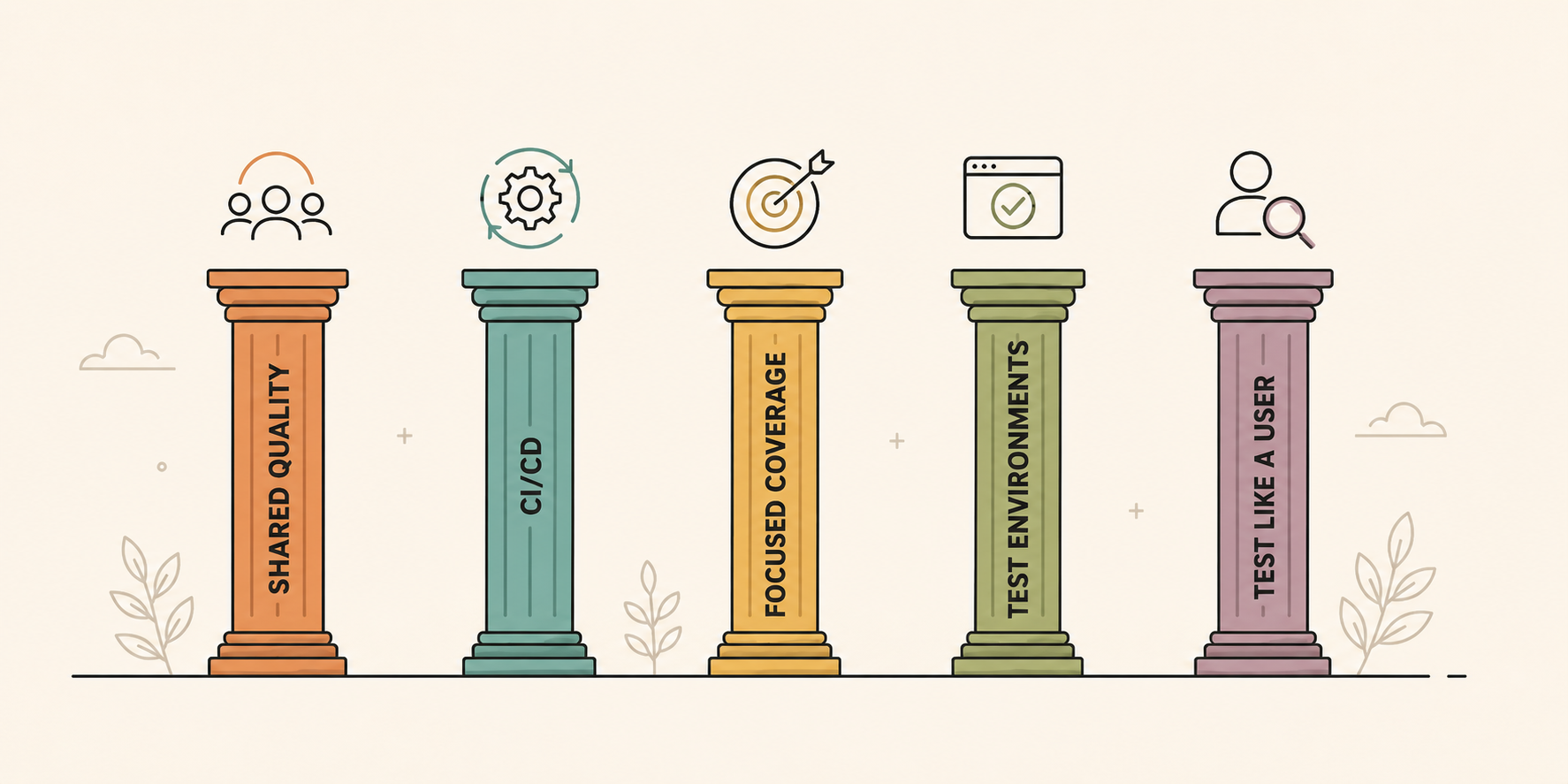
Five practical QA practices for shared quality ownership, CI/CD testing, useful automation coverage, reliable test environments and user-focused testing.
Software teams want to move fast. That is nothing new.
The problem starts when speed and quality are treated as two things fighting against each other. Testing gets pushed to the end, automation grows without a clear plan, test suites become slow and unreliable, and eventually the team starts skipping checks because the QA process itself has become a blocker.
Good QA should not work like that.
Over time, I have noticed that many testing problems can be brought back to a few simple principles. Quality needs shared ownership. Testing needs to fit naturally into the development process. More test coverage is not automatically better. Test environments need to be reliable. And whether testing is manual or automated, the product still needs to be looked at through the eyes of a real user.
This article focuses mainly on functional testing and the important flows users depend on. Security, performance and other specialised areas deserve their own discussion.
With that in mind, here are five QA practices that can make a real difference to how software teams test and release products.
1. Product quality should not belong only to QA
One of the biggest mistakes a software team can make is treating quality as something owned by one person or one department.
Development builds the feature. Product defines the behaviour. Then QA receives the finished work and is expected to find everything that is wrong with it. That setup creates the wrong expectation from the beginning.
QA has an important role, but product quality needs to be shared by the people building the product as well. Developers understand the technical changes. Product understands the business expectations. QA brings the risk, testing and user perspective. These roles should work together.
This does not make QA less important. Quite the opposite. QA becomes more useful when involved early enough to influence the work instead of only checking it afterwards.
A QA engineer can help define testing areas, question unclear requirements, create or review test scenarios, perform exploratory testing, investigate automated failures and maintain regression coverage. But quality decisions should not happen in isolation from development and product.
The whole team needs to understand what is important enough to test and what risks the release carries.
Build test planning into product planning
Testing should be discussed when the feature is discussed.
If a new feature is being planned, the team should already be asking what needs to be verified. Which user flows are changing? What existing areas may be affected? Which scenarios are high risk? Does the regression suite need to be updated?
A feature should not be considered fully planned if nobody has thought about how it will be tested.
This does not require creating a hundred test cases before development begins. Sometimes a few clearly defined acceptance criteria and risk areas are enough.
The important thing is that testing is not an afterthought. When the team waits until the feature reaches QA to think about coverage, gaps are almost guaranteed.
Testing information should be accessible
Testing should not live in a tool or process that only one person understands.
The team should be able to see which important flows have coverage, which areas are risky and what the current testing status is. This becomes especially important with automated tests.
Developers should understand what the regression suite covers. Product should be able to understand which major user flows are protected. QA should not become the only person capable of explaining why a test exists.
The easier testing information is to understand, the more quality becomes part of the team rather than a separate QA activity.
Developers should be close to automated testing
Developers are already responsible for deploying code and understanding what has changed. That makes them an important part of automated test execution.
When automated tests run as part of the development or release process, failures should be visible immediately. Developers often have the best context to understand whether the failure comes from a real defect, an intended product change or an outdated test.
This is where close collaboration with QA matters. Not every failed automated test represents a bug.
Sometimes the product changed correctly and the test needs to be updated. Sometimes the test is unstable. Sometimes the failure exposes a genuine regression. The team needs to be able to tell the difference quickly.
A test suite that produces failures nobody understands will eventually lose trust. And once the team stops trusting the tests, they stop paying attention to them.
2. Effective testing should be part of CI/CD
Release pressure has a way of pushing testing aside.
The deadline gets closer. A few changes arrive late. Somebody suggests doing the regression checks after release. Everyone promises it is only this one time. Then it happens again.
A good CI/CD process helps remove some of those decisions from the team.
Important checks can run automatically at defined points in the development and release process. Testing becomes part of how software moves toward production rather than something people need to remember to do manually every time.
This is one of the biggest advantages of continuous testing: feedback comes earlier.
A problem found shortly after a code change is usually easier to investigate than the same problem discovered after several more features have been merged.
Add coverage before merging important changes
When a new feature introduces important behaviour, the required test coverage should be considered before the change is merged.
If planning identified a critical flow that needs regression protection, that coverage should not remain a future task indefinitely. Otherwise the feature reaches the main branch without the protection the team already agreed was necessary.
Not every feature needs automation.
But when the team decides that a scenario belongs in the automated regression suite, it should normally be added close to the feature itself. The longer the delay, the more likely it is to be forgotten.
Review test coverage during code review
Code review should not only ask whether the implementation looks correct.
For important product changes, it can also ask whether the necessary test coverage exists:
- Has an existing test been updated?
- Does a new scenario need to be added?
- Is a high-risk behaviour now unprotected?
These are quality questions, not only QA questions.
A team that reviews testing coverage together is much less likely to discover major gaps at the end of the release cycle.
Run important end-to-end checks as part of the release
Critical end-to-end tests should run automatically at meaningful quality gates.
For some teams, this may happen during pull or merge requests. For others, the full suite may run before deployment to staging or production. The exact process depends on the product.
But the principle is simple. If a test protects a business-critical flow, the release process should not depend on somebody remembering to run it manually.
And when a critical automated test fails, the team should investigate the failure before continuing the release. Otherwise the automated test is mostly decoration.
3. More test coverage is not always better
This may sound strange coming from QA, but not everything needs a test. Especially not an automated test.
Automated coverage has a cost. Tests need to be written, reviewed, executed, debugged and maintained. The product changes and the tests need to change with it.
A large test suite can look impressive while quietly becoming one of the biggest bottlenecks in the release process.
When a regression suite takes too long to run or produces too many unreliable failures, teams start looking for ways around it. They rerun tests until they pass. They ignore known failures. They skip the suite for urgent releases.
At that point, more coverage has actually made the QA process weaker.
The goal should be useful coverage.
Focus on the flows that matter most
Think about how roads are cleared after heavy snow.
The main roads are usually cleared first because they affect the largest number of people. Smaller roads may come later, while some barely used roads may not be prioritised at all.
Testing can work the same way.
Start with the product flows that matter most to users and the business:
- Account access
- Payments
- Critical transactions
- Core product actions
- Important data flows
If one of these breaks, the team will probably want to fix it immediately. Those areas deserve strong regression coverage.
A rarely used setting that the team would leave broken for two weeks probably does not need the same testing depth.
The same thinking applies to browsers, devices and platforms. Test where the users actually are.
There is little value in maintaining extensive automated coverage for an environment almost nobody uses unless the business has a specific requirement for it.
Quality does not mean testing everything equally. It means understanding where failure matters.
Only automate what you can maintain
Creating a new automated test is easy to justify. Removing one feels more uncomfortable.
But test suites need maintenance just like production code.
If the team already struggles to maintain existing tests, adding another hundred scenarios is unlikely to solve the problem.
Sometimes the correct quality decision is to remove a low-value test.
Ask whether the scenario still matters:
- Does the feature still exist?
- Would the team urgently fix the behaviour if it broke?
- Does another test already cover most of the same flow?
- Is the maintenance cost higher than the risk being protected?
Test suites should evolve with the product.
Old tests should not remain forever simply because somebody once created them.
Keep automated tests focused
Short tests are usually easier to understand, faster to run and simpler to maintain.
A test that covers registration, login, profile changes, payment, order creation and logout in one long flow may appear efficient. Then it fails halfway through.
Now the team needs to understand which part actually caused the problem.
Long automated flows also create more opportunities for unrelated changes to break the test.
Where possible, test one focused user journey at a time.
Smaller tests make failures easier to investigate. They also make the purpose of the test much clearer.
Fix or remove broken tests quickly
A permanently failing test is dangerous.
At first, everyone knows it is broken. The team ignores it. Then another test begins failing. That one is ignored as well.
Eventually the test report becomes a mixture of known failures, unstable tests and genuine regressions. Nobody knows what matters anymore.
This is how trust in automation disappears.
When a test breaks, decide what happened:
- Is there a real product defect?
- Did the product intentionally change?
- Is the test unreliable?
- Does the scenario still need coverage?
Fix the test, fix the product or remove the test.
Leaving it permanently broken should not become the normal solution.
4. A test is only as useful as the environment it runs in
Test environments are often one of the least exciting parts of QA. They are also one of the most common sources of wasted testing time.
A defect appears in QA but cannot be reproduced in staging. The environment has old code. The database contains strange test data from three months ago. Two testers are using the same account. A developer redeploys a feature while somebody is halfway through regression testing.
Suddenly, nobody knows whether the application is broken or the environment is simply inconsistent.
Good testing requires a predictable environment.
Keep test environments consistent
The more environments differ from each other, the harder defects become to investigate.
Where possible, environment creation and deployment should be standardised.
The team should understand how a testing environment is configured and avoid unnecessary manual differences between instances.
Consistent environments make bugs easier to reproduce. They also make automated tests more reliable.
When a failure only appears because one environment has an unknown configuration change, the team wastes time investigating the wrong problem.
Make it clear which version is being tested
When QA reports a defect, the team should know exactly which version of the application was tested.
This sounds obvious. In practice, it is often surprisingly unclear.
Staging may contain several changes. QA may have been testing an older build. A feature branch may have been redeployed halfway through the test session.
The environment should make the current code version visible or easy to identify.
This makes defect reporting and investigation much simpler. A developer should not need to spend twenty minutes figuring out whether the reported issue even exists in their current code.
Feature-specific environments can reduce confusion
For larger teams or products with several active changes, giving important feature branches their own testing environment can be extremely useful.
QA can test the specific change without unrelated work appearing in the middle of the session. Developers can also validate the full feature before it reaches a shared environment.
This supports earlier testing and reduces collisions between teams.
Of course, not every company needs an environment for every branch. The infrastructure cost and complexity need to make sense.
But when several large features are constantly interfering with each other in one shared QA environment, separate environments may solve a lot of unnecessary problems.
Prepare useful test data
Test data has a huge impact on testing efficiency.
Imagine testing a page that shows a user's past transactions. One option is to create a new account and manually perform twenty transactions before testing the page. Another option is to deploy the environment with prepared test accounts containing the required data.
The second approach saves time every time the scenario is tested.
Good test data should help the tester reach the important product state quickly.
It can include:
- Users with different roles
- Accounts in specific states
- Completed transactions
- Failed actions
- Boundary-value data
The goal is not to fake the test.
The goal is to avoid repeating unnecessary setup work.
5. Test like a real user, even when using automation
Automation is good at repeating instructions. Users are good at doing things nobody expected.
Good testing needs to understand both.
Automated tests should protect important behaviour, but teams should remember what the software is actually built for.
A user does not care whether the DOM element exists. They care whether they can complete the action.
They do not care that the backend returned the correct internal value if the interface shows the wrong information.
Testing should stay connected to the actual user experience.
Use the right automation for the problem
Different automated tests answer different questions.
- Unit tests help validate individual pieces of code.
- API tests help check backend behaviour and business rules.
- End-to-end tests validate important product flows.
- UI-focused automation can verify behaviour closer to what the user actually sees.
There is no single automation layer that replaces everything else.
The testing approach should match the risk.
If the main concern is whether the backend rejects an invalid state, an API test may be better than clicking through the full UI.
If the concern is whether the user can complete the checkout process, an end-to-end test may make more sense.
The tool should follow the testing problem. Not the other way around.
Know when automation is not the answer
Automation works best for repeatable checks with clear expected results.
It is especially useful for stable features and regression scenarios that need to be verified regularly.
But some testing needs human judgement.
A new feature may still be changing every day. A user flow may feel confusing even though every button technically works. An error message may be correct but completely unhelpful. A complex scenario may require investigation rather than following a fixed script.
This is where manual and exploratory testing remain important.
The question should not be, “Can we automate this?” Most things can probably be automated with enough time.
The better question is: Should we automate this?
Good automation removes repetitive work and protects important behaviour. It should give QA more time to investigate the things that machines do not understand well.
Final thoughts
Good QA does not need to be complicated. But it does need to be intentional.
Quality should be shared across product, development and QA. Testing should be considered during planning and built into the development process. Automated coverage should focus on the flows that matter instead of growing without control. Test environments should make defects easier to reproduce rather than creating new confusion. And even with strong automation, teams still need to look at the product like a real person would.
The biggest QA problems often appear when teams lose sight of these basics.
They automate everything because more tests sound better. They allow broken tests to remain in the suite. They test in unstable environments. They involve QA only after development finishes. Then they wonder why testing feels slow.
A strong QA process should make releases clearer and risks easier to understand.
It should help the team move with more confidence.
Not create another obstacle they need to work around.
Need practical QA support?
Laidoner Solutions helps software teams with manual QA, API testing, localization review, release checks and clear defect reporting.
Contact Us